

Breaking: Drake’s Defamation Lawsuit Against UMG Thrown Out by Federal Judge
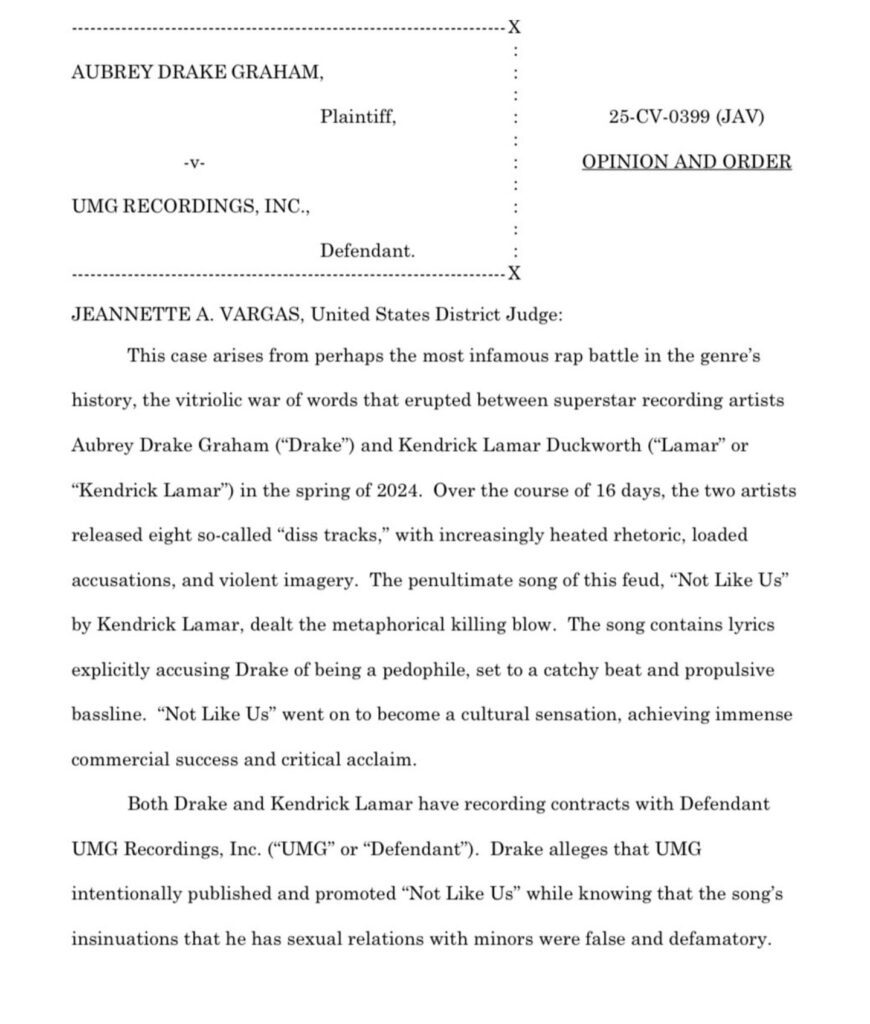
In a major turn of events in one of the most closely watched legal battles in music this year, a federal judge has dismissed Drake’s defamation lawsuit against his own label, Universal Music Group (UMG). The suit stemmed from his long-running feud with Kendrick Lamar and centered on Lamar’s diss track “Not Like Us.”
Here’s what we know so far — plus what this means for Drake, UMG, and the broader debate over artistic expression in hip-hop.
The Legal Fight: Claims, Counterclaims & Context
What Drake Alleged
Drake’s lawsuit, filed in January 2025 in the U.S. District Court for the Southern District of New York, accused UMG of defamation. His central claim: UMG “published, promoted, and distributed” Kendrick Lamar’s “Not Like Us” despite knowing the song contained false and harmful allegations—specifically that Drake was a pedophile—which he argued damaged his reputation, brand value, and personal safety.
Drake also contended that UMG used promotional tactics—such as streaming manipulation, payola, bots, and deliberate marketing—to artificially amplify the track’s reach.
Interestingly, Drake’s suit did not name Kendrick Lamar as a defendant; instead, it targeted the record company itself for facilitating the distribution and promotion of the track.
UMG’s Defense & Motion to Dismiss
From the outset, UMG fought back aggressively, filing motions to dismiss the lawsuit. Their defense hinged on several key arguments:
- The lyrics in “Not Like Us” constitute protected opinion, rhetorical hyperbole, and “nonactionable” statements, not factual claims that can give rise to defamation liability.
- Allowing Drake’s claims to proceed would threaten artistic freedom in rap, chilling the genre’s tradition of insults, exaggeration, and sharp rhetoric.
- UMG also pointed out what it viewed as Drake’s inconsistency: earlier, Drake had signed a petition opposing the use of rap lyrics as evidence in criminal cases, advocating that artistic expression should be interpreted as creative vision—not literal fact.
- UMG challenged whether listeners would reasonably interpret Lamar’s lyrics as literal, verifiable statements.
In March 2025, UMG formally filed a motion calling Drake’s case “misguided” and arguing that it should be tossed with prejudice.
The Court’s Ruling: Why the Case Was Dismissed
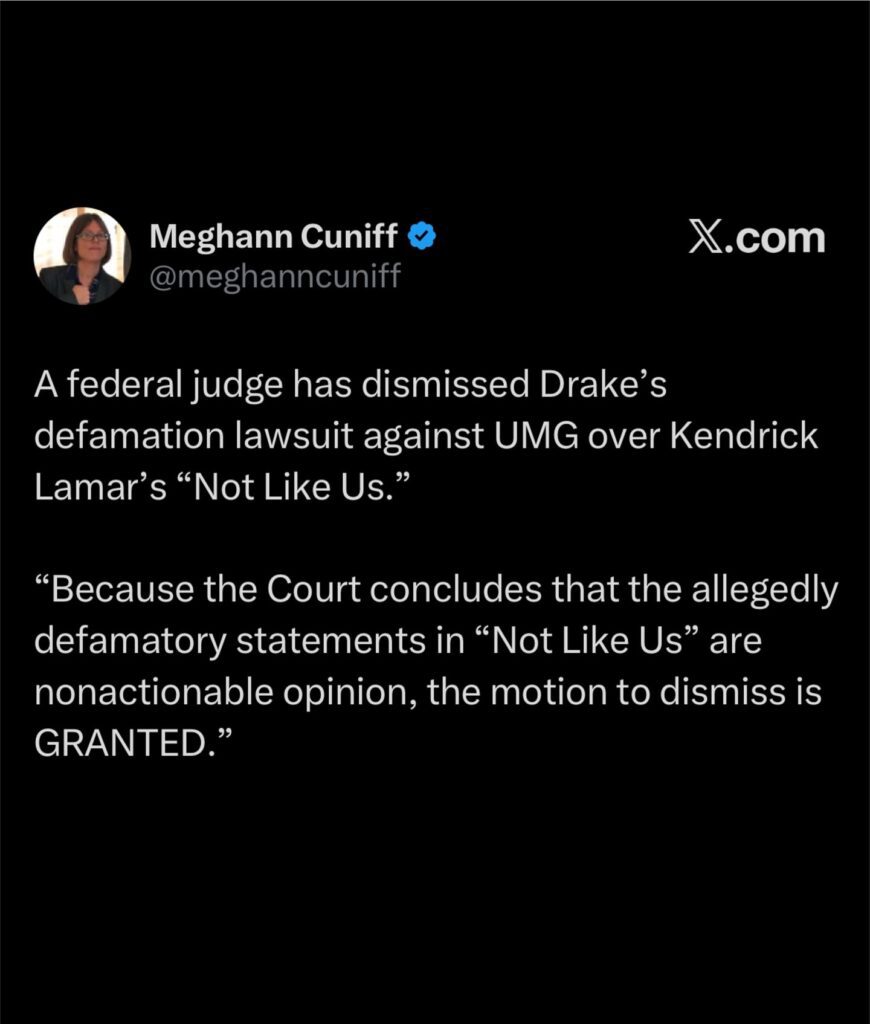
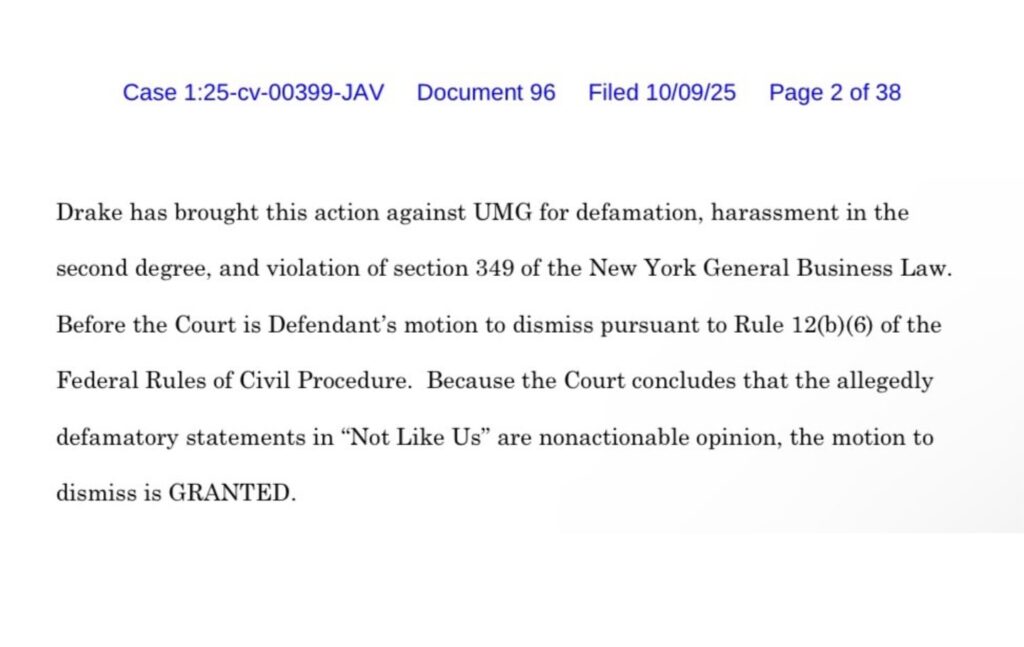
On October 9, 2025, U.S. District Judge Jeannette A. Vargas dismissed the case, concluding that under U.S. law, the lyrics in question fall under opinion or rhetorical expression rather than actionable fact.
A few key excerpts and legal reasoning from the ruling:
- The judge framed the conflict as emerging from a “vitriolic war of words” in an “infamous rap battle,” not a factual media publication.
- Even allegations as serious as those of criminal conduct (e.g. pedophilia) may be nonactionable in context if they are part of expressive, hyperbolic, artistic content.
- The judge noted that the average listener would not interpret Lamar’s lyrics as literal statements of fact, but rather as part of the expressive, exaggerated theater typical of diss tracks.
- Because of that, the court found the statements to be “nonactionable opinion”, meaning Drake’s defamation claim could not survive.
The dismissal appears to be with prejudice—i.e. Drake cannot refile the same claim in that court.
Implications & Repercussions
For Drake
- The dismissal is a serious legal loss, effectively affirming that courts will be reluctant to treat diss tracks as sources of binding factual statements.
- Drake may still have recourse to appeal, but he faces an uphill battle given precedents protecting artistic expression.
- The outcome may push him to reassess his legal strategy: whether to lean more into public relations or to pursue narrower legal claims, if any remain viable.
For UMG & Artists at Large
- This ruling reinforces a high threshold for defamation claims in creative works—especially in genres like rap that thrive on metaphor, insult, and provocation.
- UMG’s victory also clears the way for labels to continue promoting controversial content, confident of a legal shield when the content is symbolic or rhetorical.
- Public debates about the limits of free speech in music — especially where serious accusations are involved — will almost certainly resurface in future high-stakes lyric battles.
On the Broader Rap Feud Narrative
The dismissal may legally close the case, but it doesn’t end the conversation. What began as another chapter in the Drake vs. Kendrick Lamar saga has now sparked a deeper debate about how far “artistic expression” can go before it crosses into defamation.
For many fans, “Not Like Us” wasn’t just a diss track — it was a calculated attack that blurred the line between creative freedom and character assassination. And while the court may have chosen to view it as artistic hyperbole, others see it as a dangerous precedent that lets labels profit from smearing one of the biggest artists of our generation.
Talk of Toronto Closing Thoughts
Drake’s lawsuit was never just about money — it was about accountability. He stood up against one of the world’s most powerful record companies, calling out what he viewed as an abuse of influence and a lack of artistic integrity.
While the judge’s dismissal may seem like a setback, for Drake supporters, it reinforces his reputation as someone unafraid to fight for his name and principles, even when the system looks the other way.
At the end of the day, Drake doesn’t need a courtroom victory to prove his dominance — the culture already knows who’s really running the game.
Because for the Boy, the story’s far from over — and the mic is still his.